 USD
USD
 EUR
EUR
 AUD
AUD
 GBP
GBP
 SGD
SGD

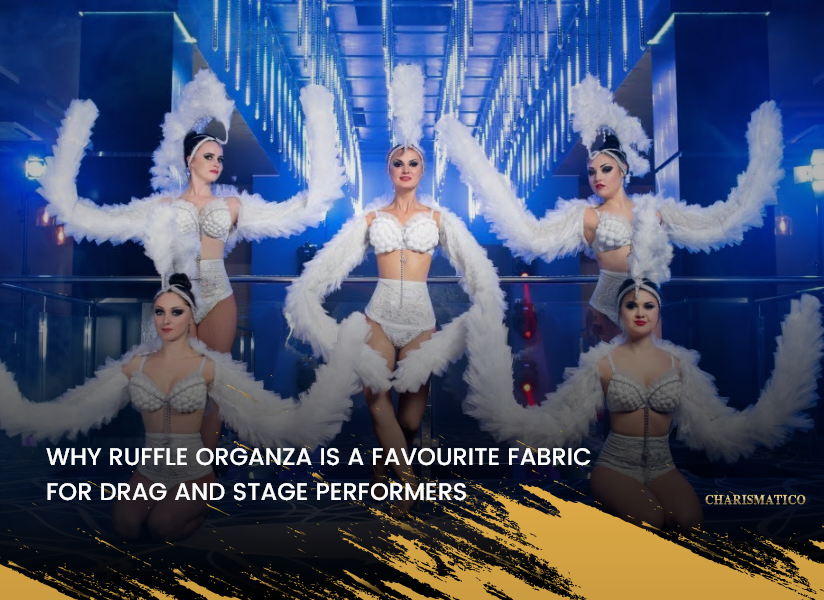
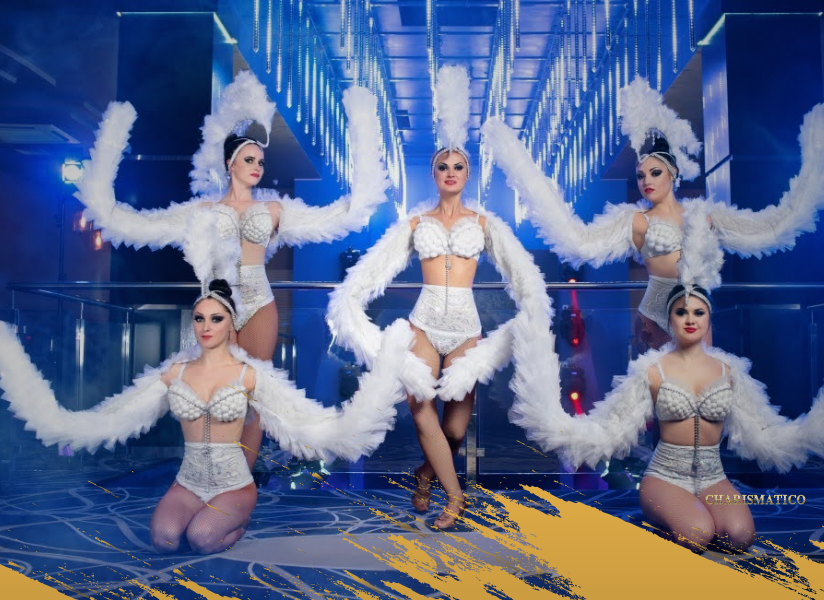
Why Ruffle Organza Is a Favourite Fabric for Drag and Stage Performers
Ruffle organza promises high drama, yet performers often worry that bold volume comes at the cost of comfort and control. On stage, every fabric choice has consequences. Too heavy, and movement feels restricted. Too soft, and the silhouette disappears under lights.
Ruffle organza sits in that rare middle ground, offering structure, lift, and fluid motion without overwhelming the body. It is a fabric that works with the performer, not against them. In this article, we explore why ruffle organza has become a staple for drag, cabaret, and stage costumes, breaking down how it performs in real conditions and how to use it effectively for stronger visual impact and practical wearability.
At a Glance
- Why ruffle organza balances volume, structure, and comfort
- How it enhances movement and visibility on stage
- What makes it more practical than other dramatic fabrics
- How performers can use it to improve costume performance
What Makes Ruffle Organza Unique as a Performance Fabric?
Ruffle organza stands out because it solves a problem most stage fabrics don’t even attempt to address. It gives you shape without weight, and movement without collapse. That balance is what makes it so reliable under real performance pressure.
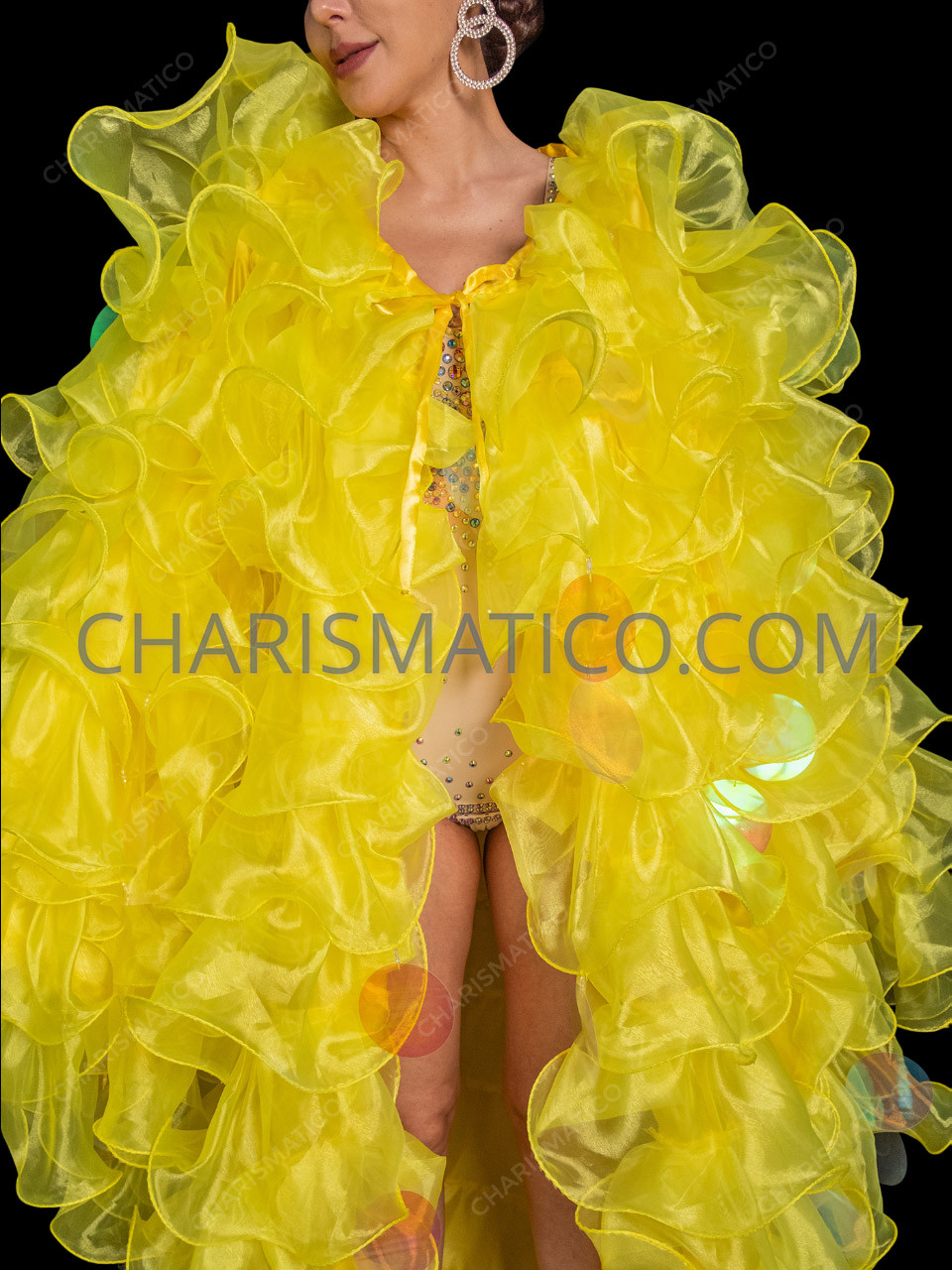
Ruffle organza can make a dramatic impact on your performance costume
Yellow ruffle organza drag coat with large sequins
What is Ruffle Organza Made of?
At its core, organza is a lightweight, sheer fabric, usually woven from polyester or silk. What changes everything is how it’s constructed into ruffles. The gathering and layering introduce structure, turning something delicate into something sculptural.
Unlike softer fabrics that drape and fall flat, ruffle organza holds its form. It creates volume that stays visible from a distance, which is critical on stage where details can easily disappear.
Why Structure Makes a Difference on Stage
Under stage lighting, fabrics behave differently than they do in a fitting room. Heat, movement, and lighting angles all play a role. This is where ruffle organza earns its place.
- It maintains its silhouette even during fast choreography
- It doesn’t cling or collapse with sweat or humidity
- It creates consistent shape from every viewing angle, including balconies and side seating
How is Ruffle Organza Different from Softer or Heavier Fabrics?
A quick way to understand ruffle organza is to compare it to common alternatives:
- Chiffon flows beautifully, but lacks structure and can disappear under strong lighting
- Satin offers shine, but adds weight and limits airflow
- Tulle creates volume, but often looks flat or overly soft unless heavily layered
Ruffle organza sits between these extremes. It’s structured, but not stiff. Lightweight, but not flimsy. That middle ground is what allows performers to move freely while still commanding attention.
Why Do Drag And Stage Performers Prefer Ruffle Organza?
There’s a reason ruffle organza shows up again and again in high-impact stage looks. It doesn’t just look dramatic. It performs.

Our selection of ruffle organza drag coats are carefully designed to enhance your stage presence
Sunset flame iridescent ruffle organza drag coat
For many performers, the goal is not simply to wear a costume, but to amplify presence. That’s where ruffle organza consistently delivers. It reacts to movement in a way that feels intentional, almost choreographed, even when it isn’t.
How Does Ruffle Organza Enhance Stage Presence?
Every step, turn, or pose becomes more visible. The layered ruffles catch air and light at the same time, creating motion that reads clearly from across the room.
This matters more than people expect. On larger stages, subtle details disappear quickly. Fabrics that don’t project outward tend to flatten visually.
Ruffle organza enhances stage presence by:
- Expanding the performer’s silhouette without adding heaviness
- Creating continuous motion, even in still moments
- Reflecting light in layers, adding depth instead of a single flat surface
The result is a costume that feels alive on stage.
Does Ruffle Organza Work Across Different Performance Styles?
Not every performer needs the same kind of impact. A high-energy drag number has very different demands compared to a slow cabaret routine. Yet ruffle organza adapts surprisingly well across styles.
In faster performances, it exaggerates movement. Spins feel bigger. Transitions feel sharper. The fabric keeps up without dragging behind or resisting motion.
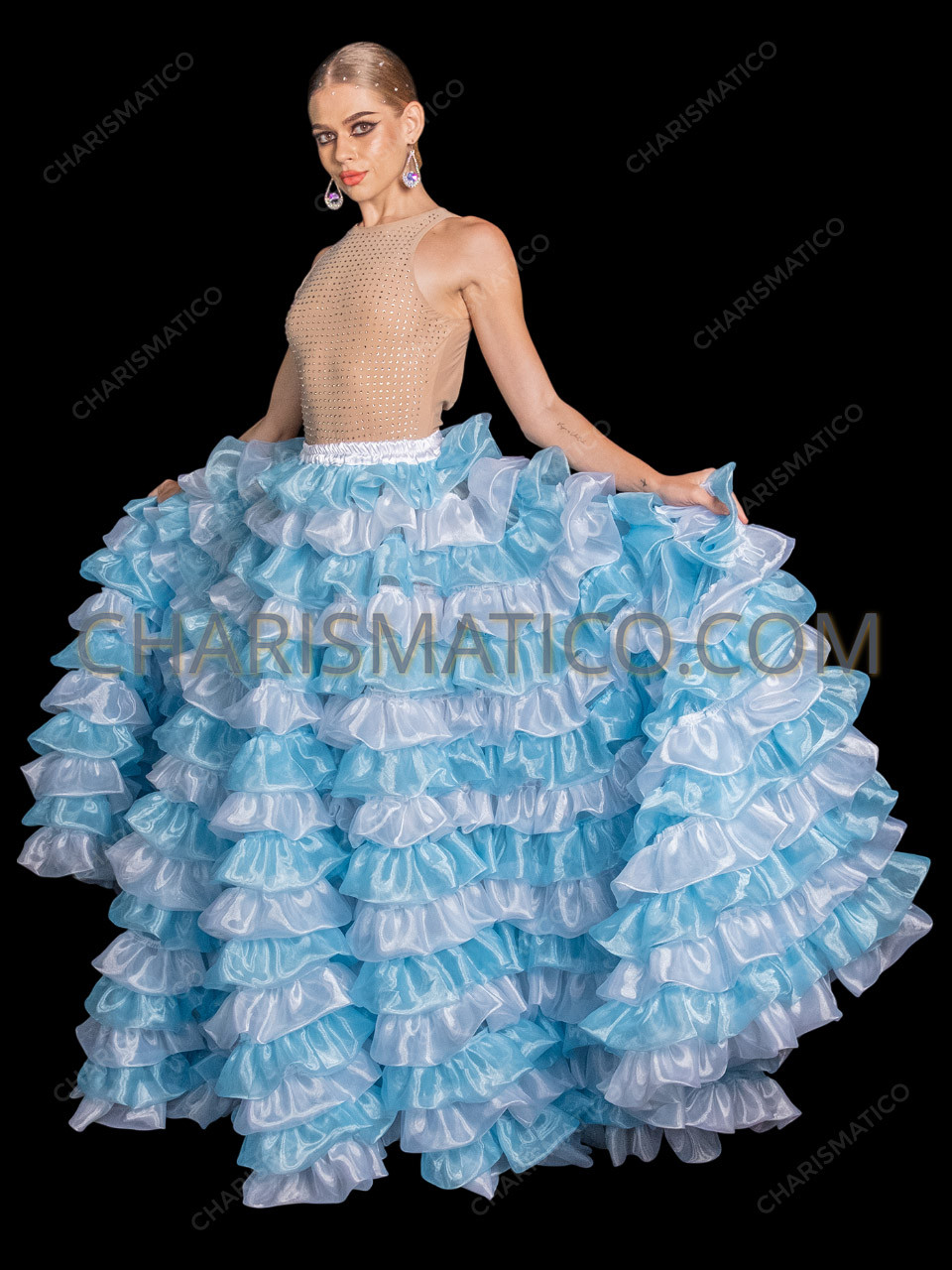
Our ruffle organza skirts are tailored to elevate your movement
Voluminous sky blue & white organza ruffle full circle skirt
In more controlled settings, it does something subtler. It holds shape. It frames the body. Even minimal movement carries weight because the structure is already doing part of the work.
Where Performers Notice The Difference Most With Ruffle Organza
Certain moments expose weak fabrics immediately. Ruffle organza tends to shine in exactly those situations:
- Entrances where first impressions matter
- Quick turns or spins that rely on fabric response
- Reveal moments where layers need to separate cleanly
- Extended performances where comfort becomes a factor
Instead of fighting the costume, performers can rely on it.
Ruffle Organza Vs Other Popular Costume Fabrics
Choosing fabric is rarely about what looks best on a hanger. It’s about what holds up under pressure, lighting, and movement. Ruffle organza tends to stand out not because it dominates one category, but because it performs consistently across all of them.
How Does Ruffle Organza Compare To Tulle, Chiffon, And Satin?
Instead of thinking in terms of “better or worse,” it helps to look at how each fabric behaves in real performance conditions.
|
Fabric Type |
Weight |
Structure |
Movement Response |
Stage Visibility |
Best Use Case |
|
Ruffle Organza |
Lightweight |
High |
Reactive, controlled |
High, multi-dimensional |
Dramatic silhouettes, layered looks |
|
Tulle |
Very light |
Medium (layered) |
Soft, airy |
Moderate, can flatten |
Volume base, underskirts |
|
Chiffon |
Light |
Low |
Flowing, fluid |
Low under strong lights |
Soft drapes, romantic styles |
|
Satin |
Medium-heavy |
Low |
Limited, heavier feel |
High shine, less depth |
|
Why Performers Often Move Away From Softer Fabrics
Chiffon and satin both have their place, but they require careful styling to work on stage. Chiffon can look beautiful in motion, yet it often lacks the structure needed to maintain a clear silhouette. Satin reflects light strongly, but that shine can flatten the overall look, especially from a distance.
Tulle sits somewhere in between. It creates volume, but without layering or shaping, it can feel soft rather than defined.
Ruffle organza solves these trade-offs in a more balanced way. It holds shape like a structured fabric, but still moves enough to feel dynamic. That combination reduces the need for excessive layering, which in turn keeps the costume lighter and easier to wear.
When Does The Difference Become Noticeable?
A spin in chiffon feels fluid, but it may not project outward. A satin skirt might hold its line, but it won’t expand or react in the same way. With ruffle organza, the fabric lifts and responds, creating a visual echo of the movement itself.
This is why performers often reserve it for key pieces. A layered skirt, a dramatic ruffle organza sleeve, or even a full silhouette built around volume. In more elaborate designs, such as a sculpted ruffle organza gown, the fabric doesn’t just support the look. It defines it.
Styling Ideas: How To Use Ruffle Organza For Maximum Impact
Designing with ruffle organza is less about adding volume everywhere and more about placing it where it counts. The difference between a costume that feels overwhelming and one that feels intentional often comes down to control.
Statement Pieces That Carry The Look
A full silhouette, like a layered stage gown, creates instant presence before the performer even moves. The structure frames the body and builds anticipation. For example, a dramatic ruffle organza gown can anchor an entire look, allowing the rest of the styling to stay relatively minimal.
Outer layers work just as effectively, especially for entrances and reveals. A voluminous ruffle organza coat or jacket adds height, width, and movement, then can be removed to shift the energy of the performance without a full costume change.
How Do You Combine Ruffle Organza With Other Materials?
Ruffle organza rarely needs to do everything on its own. In fact, it works best when paired with contrasting textures.
- Pair with sequins or metallic fabrics to reflect light differently across surfaces
- Use stretch materials underneath for comfort and mobility
- Add sheer panels to avoid visual heaviness while keeping dimension
Placement Changes Everything
One of the most common mistakes is overusing ruffles across the entire costume. It seems like more volume equals more drama, but in practice, it can dilute the effect.
Instead, focus on zones that naturally draw attention:
- Shoulders and sleeves for upper-body emphasis
- Hips and skirts to exaggerate movement during turns
- Back panels for trailing motion during entrances or exits
A well-placed ruffle will often outperform a fully layered outfit. It gives the audience something to follow visually.
Color And Layering Techniques That Actually Work On Stage
Under stage lighting, color behaves differently. Flat tones can disappear, while layered shades create depth.
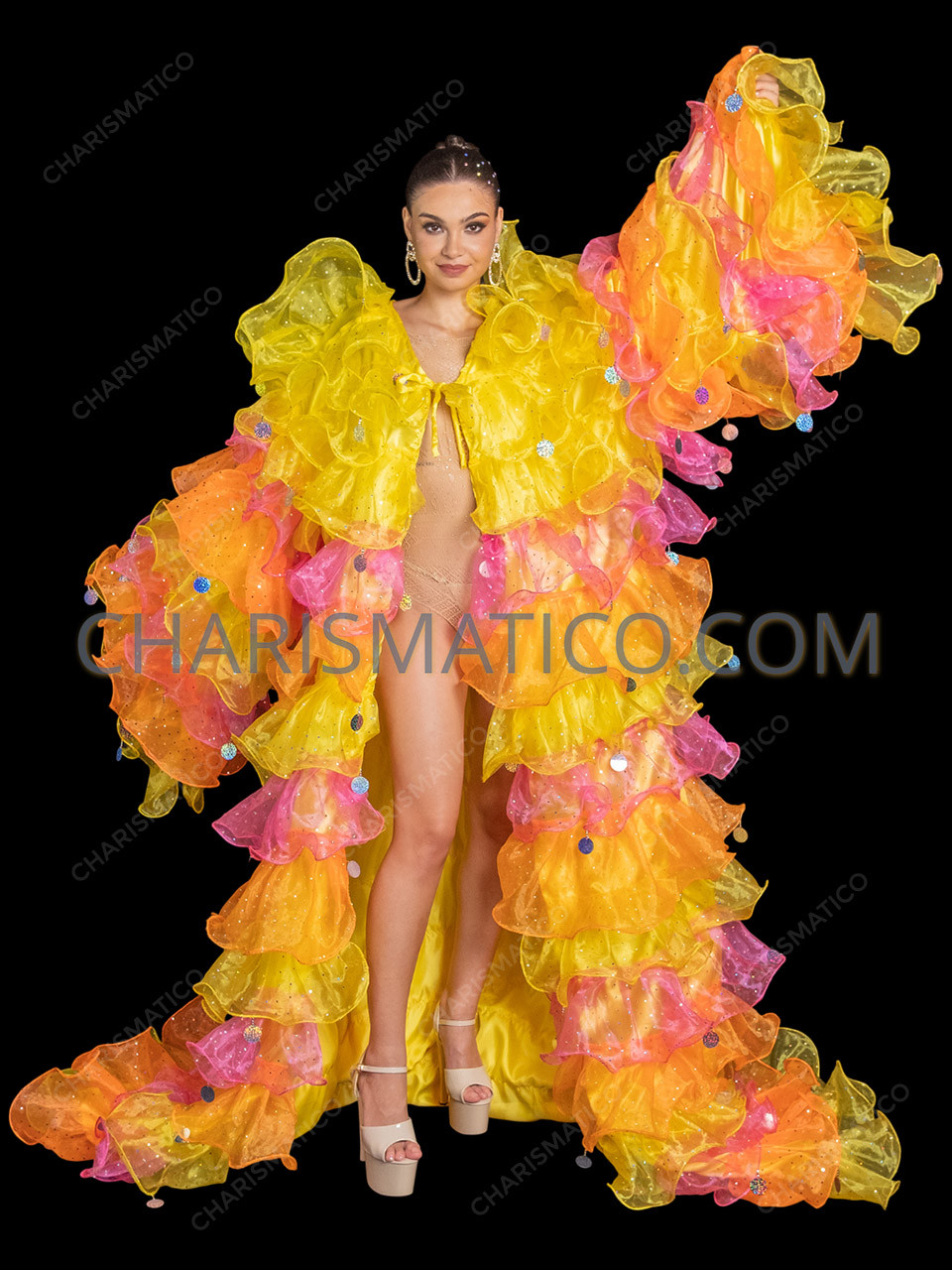
Layered ruffle organza coats make for a wonderful stage effect
Sunburst glitter organza ruffle fantasy drag show coat
Ruffle organza is particularly effective here because of its translucency. When layered, it produces subtle variations in color that shift as the performer moves.
A few approaches that consistently work with ruffle organza:
- Layering similar tones (for example, red over burgundy) to create richness
- Using contrasting colors in different layers for a more dramatic effect
- Choosing brighter hues that remain visible under strong lighting
Where Performance And Fabric Finally Align
The difference between a good costume and a great one often comes down to how it behaves when it matters most. Under lights, in motion, and in front of an audience that notices more than you think. Ruffle organza earns its place not because it is dramatic on its own, but because it supports the performer in delivering that drama consistently.
What stands out over time is reliability. A fabric that holds its shape, responds to movement, and enhances visibility removes one layer of uncertainty from the performance. That shift allows performers to focus on timing, expression, and connection rather than adjusting or compensating mid-show.
From our experience at Charismatico working closely with stage performers, the most effective looks are rarely the most complicated. They are the ones where fabric, structure, and movement are aligned with the intention of the performance. Ruffle organza simply makes that alignment easier to achieve, whether it is through a statement silhouette or a well-placed layer.
What Performers Should Remember On Stage With Ruffle Organza
- Ruffle organza works best when used with intention, not excess
- Strategic placement often creates more impact than full coverage
- Movement is amplified when the fabric is allowed to respond naturally
- Layering and color choices directly affect visibility under stage lighting
- The right fabric reduces distractions, allowing stronger performance focus
- Strong costume design starts with how it performs, not just how it looks