 USD
USD
 EUR
EUR
 AUD
AUD
 GBP
GBP
 SGD
SGD

The History of the Showgirl, From Paris Revues to the Las Vegas Strip
A six-foot plume sweeping across a Las Vegas stage is the end point of a story that started more than a century earlier, and showgirl history explains how it got there. The showgirl took shape in the cabarets and revue halls of Belle Époque Paris, crossed to Broadway with the Ziegfeld Follies, spread through Hollywood musicals and found her most famous home on the Las Vegas Strip. Along the way, the costume moved from ruffled cancan skirts to crystal crowns and towering feather headdresses.
Several decisions made along that route still guide how showgirl costumes are designed today, from building for height to making sure a look reads from the back row. Here is how the showgirl evolved, and which of those rules are worth keeping on your own stage.
|
At a Glance
|
Where Did the Showgirl Begin?
The showgirl began in Paris in the decades after the Franco-Prussian War ended in 1871. During the Belle Époque, venues such as the Folies Bergère and the Moulin Rouge built their programs around variety acts, comedy and the high-kicking cancan, as HISTORY's account of the showgirl's Parisian origins describes.
These stages were not yet about towering headdresses. The costume's job was volume in motion: layers of ruffled skirt that burst outward with every kick and turned a line of dancers into one moving shape.
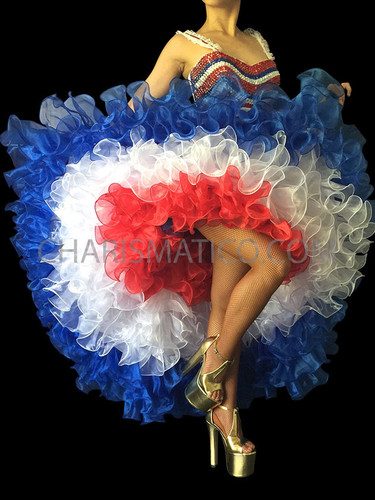
Ruffled cancan volume, a Paris revue staple, still anchors cabaret costume design.
Floor-length red, white and blue ruffled cancan dance costume
Paris also gave later shows their vocabulary of glamour. When Broadway and Las Vegas wanted to signal spectacle, they borrowed French names to do it.
How Did the Ziegfeld Follies Change the Showgirl Look?
The Ziegfeld Follies turned the showgirl from a dancer into a centerpiece. Florenz Ziegfeld launched the Follies on Broadway in 1907, modeled on the Folies Bergère, and insisted on extravagance. Costumes by designers including Erté paired shimmering gowns and jewels with a feather headdress that could rise several feet above the performer.
Ziegfeld chose his showgirls for presence rather than dance technique, so they often walked and posed while the costume did the talking. The headdress became the focal point of the look, and it has stayed there ever since. Hollywood carried the image to a mass audience in the 1930s, when Busby Berkeley musicals filled the screen with entire choruses.
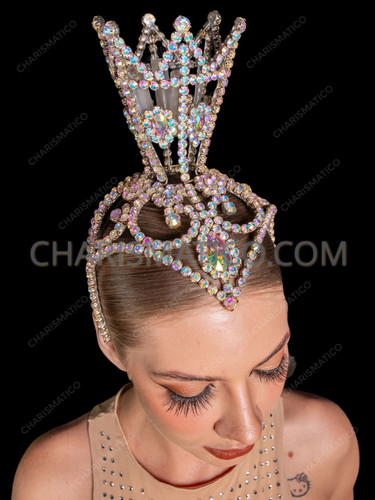
Crown-style headdresses carry forward the Follies idea of the performer as centerpiece.
Crystal AB crown showgirl headdress with sparkling upright points
Why Did Las Vegas Become the Home of the Showgirl?
Las Vegas became the showgirl's home because the city built its postwar identity around spectacle, and the revue was its headline act. In 1958, Lido de Paris opened at the Stardust, bringing the Parisian revue straight to the Strip, and its success set off a wave of rival productions.
The name most tied to that era is producer Donn Arden. With his collaborator Miss Bluebell (Margaret Kelly), Arden staged Lido de Paris, Hallelujah Hollywood and Jubilee! at the Stardust, MGM Grand and Desert Inn. Jubilee! opened in 1981 with costumes by Bob Mackie and Pete Menefee and ran until February 2016, closing as the longest-running production show in Las Vegas.
Vegas also shaped the costume through casting. According to UNLV's history of the showgirl, showgirls often had to meet a minimum height requirement so they stayed visible on stage. Costumes then multiplied that height: plumes stretched six feet high, rhinestones were stitched on by the thousands and headdresses were matched with backpieces that framed the performer from behind. Many original costume sketches from these shows are preserved in the UNLV Special Collections Showgirls archive.
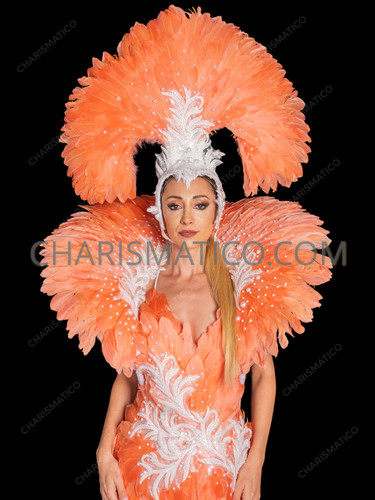
The matched headdress and backpack silhouette became the signature of the Vegas revue.
Peach feather showgirl headdress with matching wing backpack set
The full showgirl costume most people picture today, plumes above and a fan of feathers behind, is essentially the Las Vegas revue look.
Which Showgirl Design Rules Still Shape Stagewear Today?
Five rules from the revue era still guide how showgirl costumes are built. Each started as a practical answer to a specific stage problem.
|
Rule |
Where It Came From |
How It Shows Up Now |
|
Build for height |
Vegas height minimums and Ziegfeld headdresses |
Towering headdresses add visual height, whatever the performer's own |
|
Frame with symmetry |
Revue fan shapes and grand staircase finales |
Balanced headdress and backpack sets |
|
Commit to one color story |
Jubilee! costumes built around jewel tones [verify: Stage 4] |
Coordinated sets in a single bold color |
|
Design for the back row |
Large Strip theaters |
Bold crystals and plume scale over fine detail |
|
Design for the walk |
The showgirl's slow, posed strut |
Looks that stay complete while walking and posing, not only dancing |
The materials behind these rules, from sequin size to feather type, are covered in our guide to the art of the showgirl costume.
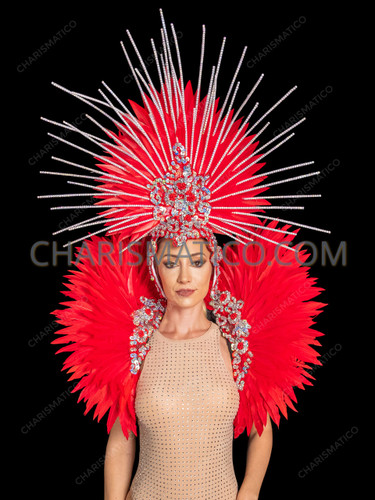
Fan symmetry and a single bold color, two revue rules in one set.
Red crystal spiked fan showgirl headdress and matching backpack
What Should Today's Performers Not Copy From the Vegas Era?
The Vegas silhouette is worth keeping. The Vegas weight is not. UNLV's archivists note that some headpieces weighed up to 30 pounds, worn by performers who sometimes danced six or seven days a week.
Most performers now work in very different conditions: drag and cabaret sets, Pride parades, festival stages and one-night events, often with quick changes and no dresser waiting in the wings. A headdress that needs a resident theater's backstage crew and months of conditioning is a poor match for that schedule.
Our towering pieces are built to hold height without that burden. Organza plumes create a big, full outline with far less weight than dense layers of traditional feathers, and backpacks sit on shoulder harnesses that spread the load across the upper body instead of the head.
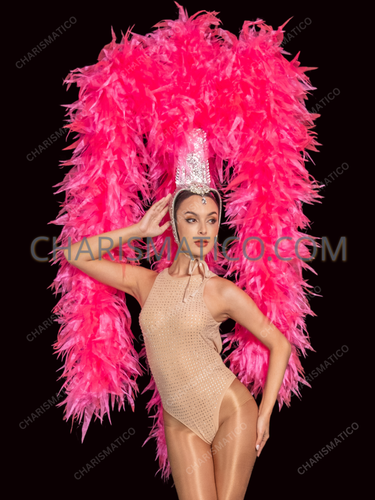
Organza plumes give Vegas-scale height with a lighter build.
Towering neon pink organza plume showgirl headdress
Which Era Should Your Showgirl Look Reference?
The right era depends on the size of the stage and how much the costume needs to do.
- Paris cabaret suits intimate venues: ruffles, cancan volume and smaller headpieces that leave room for close-up movement.
- Ziegfeld glamour suits gown-led numbers, where crystal crowns and jewelry do the work instead of plumes.
- The Vegas revue suits big stages and parade routes, where a full headdress and backpack pairing has to read from a distance.
Mixing eras works too. A Paris-style ruffled skirt under a Vegas-scale headdress is about as modern as the showgirl gets. For a specific show or decade, custom designs can be made to measure, and Charismatico builds stagewear for every chapter of the story, from the first cancan kick to the final staircase walk.